
NExT++ Singapore Workshop 2026 on Responsible AI
- Jun 1
- 5 min read
The NExT Workshop on Responsible AI was successfully held from 29 April to 1 May 2026 at I4, National University of Singapore. Centered on the theme of Responsible AI, the three-day workshop brought together researchers, industry experts, and policy leaders from Singapore, China, the UK, and beyond for in-depth discussions on the future of trustworthy and human-centered AI. The program featured invited talks, panels, poster sessions, and focused discussions on Responsible AI assurance, agentic AI, AI for healthcare, search and personalization, and embodied AI, creating a vibrant platform for cross-disciplinary exchange and international collaboration. The workshop was jointly organized by academics from the National University of Singapore, Tsinghua University, the University of Southampton, Hayou, and 6Estate, with generous support from Zhipu AI, Huawei, Scitix, and ModelBest.
The main workshop opened with welcome remarks by Prof. Tat-Seng Chua from the National University of Singapore and Prof. Maosong Sun from Tsinghua University, who introduced the key themes of the workshop and highlighted the importance of international collaboration in advancing Responsible AI.

The opening session featured invited talks by Prof. Bo Zhang from Tsinghua University and Prof. Dame Wendy Hall from the University of Southampton. Prof. Zhang discussed the transition from large language models to agentic AI, while Prof. Hall shared insights on the unintended consequences of AI technologies and the need for responsible design and governance.


The followed session focused on Responsible AI. Researchers from the RAi UK/NExT International Sandpit presented reports and proposals on advancing Responsible AI assurance models across cultures, followed by short research talks that explored new directions in trustworthy and accountable AI systems.

A panel discussion on Responsible AI brought together Prof. Dame Wendy Hall, Prof. Jie Tang, Dr. Joel Fisher, Prof. Kate Devlin, and Dr. Owen Schaefer. The panelists exchanged perspectives on AI assurance, ethics, governance, and the challenges of aligning AI development with social values across different cultural and institutional contexts.


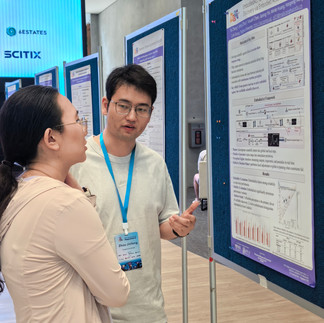
A lunch and poster session followed, where PhD students and researchers from NUS, Tsinghua University, the University of Southampton, and other institutions showcased their latest work. The posters covered a wide range of topics, including multimodal large language models, multi-agent systems, retrieval-augmented generation, AI safety, long-context reasoning, recommendation, and agentic reinforcement learning, sparking active discussion among participants.





The afternoon sessions turned to Agentic AI. In the first session, Prof. Yuxiao Dong from Tsinghua University, Dr. Long Bai from the Institute of Computing Technology, Prof. Hongning Wang from Tsinghua University, and Alan Zhao from ScitiX presented recent advances in agentic large language models, knowledge graphs, interactive education, and safety monitoring during model fine-tuning.


The second Agentic AI session continued the discussion with talks by Prof. Jiaheng Zhang and Dr. Dan Zhang from the National University of Singapore. Their presentations explored practical LLM auditing through verifiable computation and approaches to scaling trust in agentic systems.


The day concluded with a panel titled “Risks & Opportunities in the Agentic AI Era,” facilitated by Prof. Hongning Wang. Panelists including Prof. Yuxiao Dong, Prof. Jiaheng Zhang, and Chao Wang discussed the emerging capabilities of AI agents, their deployment risks, and the research directions needed to ensure reliable and beneficial agentic systems.

On the second day, the workshop began with a session on AI+X in healthcare, chaired by Prof. Zhenkai Liang from NUS. Prof. Ramesh Jain from UC Irvine, Prof. Yang Liu from Tsinghua University, Prof. Wynne Hsu from NUS, and Dr. Elven Cao from OPH shared perspectives on personal care utility, agent hospitals, AI in medicine, and the transformation of primary healthcare through AI.


The following session focused on search and personalization. Prof. Thanassis Tiropanis from the University of Southampton, Dr. Yujia Zhou from Tsinghua University, and Dr. Yang Zhang from NUS discussed decentralized information retrieval, RAG and search, and personalization with memory, highlighting how intelligent systems can better support individual and contextual needs.


A special lunch session was organized for PhD students and postdoctoral researchers, facilitated by Dr. Dan Zhang and Dr. Yang Zhang from NUS. The session provided a platform for early-career researchers to present their work, exchange feedback, and engage in open discussion with senior academics and peers.

After lunch, representatives from the PhD and postdoctoral session shared key takeaways from their discussions. The presentations reflected the workshop’s emphasis on nurturing young researchers and encouraging open, cross-institutional exchange.
The afternoon session explored Embodied AI, chaired by Dr. Zhiyong Huang from NUS. Prof. Shuicheng Yan, Prof. Cathal Gurrin, Prof. Daquan Zhou, and Prof. Mike Shou presented research on inference acceleration, generative memory, modeling human activities, reliable vision-language-action models, video generation, and world models for robot learning.


The workshop concluded with closing remarks by Prof. Maosong Sun from Tsinghua University, who reflected on the discussions and collaborations developed during the event. Prof. Wei Ji from Nanjing University also announced the upcoming NExT Workshop in Suzhou, scheduled for 23–24 October 2026.

